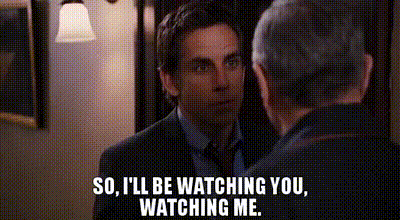
“I’ll be watching you watching me.”
The Meet the Fockers GIF I’m using captures the mood. Now somebody’s AI may be taking notes on both of us.
I’m testing both Bee Frontier and Omi wearable AI devices, so these questions are becoming practical for me. I want the benefits of AI memory, but I also want to understand what that means for the people around me.
I keep coming back to a question. How did we get comfortable with people filming arguments, fights and ordinary interactions, then posting them online, while a device intended to help someone remember a conversation raises an immediate discussion about recording consent?
The contrast feels like a double standard. We routinely see strangers turn embarrassing moments into public entertainment, yet a person using a memory aid can feel as though they need a legal department before leaving the house.
But that frustration needs a more careful answer than “everyone is recording anyway.” I want useful AI in everyday life. I also want people to be able to talk without wondering whether every sentence is entering someone else’s permanent database.
The setting matters more than the format
A video camera is not a legal permission slip. Neither is a wearable microphone.
Under federal law, a participant can generally consent to recording a covered conversation, subject to exceptions, including a criminal or tortious purpose. State law can impose stricter requirements. Florida, for example, generally requires all parties’ prior consent, while its definition of protected oral communication turns on a justified expectation against interception. The answer depends on the applicable law and the conversation, not simply whether the device records video or audio. (Federal statute; Florida consent rule; Florida definition)
Interstate calls add another complication: being physically in a one-party-consent state does not, by itself, settle which law applies. (Federal court discussion)
A shouted confrontation on a sidewalk and a quiet personal conversation at a nearby table are different situations. “In public” does not settle every privacy question. Nor does the fact that a clip is already online prove that recording or publishing it was lawful.
Capture and publication also deserve separate attention. Recording a conversation for a limited purpose, uploading it to a service and broadcasting it to strangers are different decisions with different consequences.
Remembering is useful and searchable memory is powerful
The appeal of wearable AI is easy to understand. A reminder could preserve a commitment, a name or an idea without making someone stop participating in the conversation to take notes.
The objection is equally understandable. Human memory fades. A searchable system may retain exact language, connect it to a person and make it available years later. Being overheard once is different from becoming a durable record.
Bee’s terms and Omi’s terms put responsibility for legally required consent or notice on the user. That is not the same as saying every human within microphone range must always sign a waiver. It does mean the wearer cannot assume a product’s availability makes every use lawful.
A checkbox does little to help someone handle an actual conversation. People need clear explanations of what is happening, a visible recording state and a pause control that works immediately. “I’m using an AI note-taking device. Is that okay? I can switch it off” is a better social starting point than silently relying on an onboarding screen. It is not a universal legal formula.
The institutional comparison still deserves an answer
My concern about the double standard does not disappear just because the legal questions are complicated.
If we ask individuals to justify a memory aid, we should also ask institutions to justify persistent monitoring. Who can search the records? For what purpose? How long are they kept? What prevents an unrelated use later?
We should be precise about the comparison. Maricopa’s official FAQ says its Flock license-plate cameras capture vehicle information and do not record audio. That is different from capturing a conversation. It still creates a legitimate question about the rules governing identifiable records of our lives. (City of Maricopa FAQ)
Institutional surveillance does not give me permission to ignore someone else’s privacy. It does make consistent accountability a reasonable demand.
What I would change
I would support a narrow personal-memory framework with meaningful safeguards: clear notice, an easy way to decline, limited retention and no automatic publication or unrelated reuse. Sensitive settings and unequal relationships, especially at work, deserve stronger protection. Accessibility needs deserve serious consideration rather than an assumption that one rule fits everyone.
Vendors should carry more of the burden. They decide whether recording is obvious, whether processing can stay local, how much is retained and whether data flows to another service. Those choices should be inspectable rather than buried beneath a promise that the user will comply.
Lawmakers are starting to address pieces of this. New Jersey’s A5478 proposes visible recording indicators and anti-tampering requirements. Pennsylvania’s HB2603 distinguishes some incidental public capture and ephemeral processing in its proposed device rules. Neither proposal is a general permission to record conversations, and neither is law as of November 2, 2026. California’s SB1130 was vetoed in September. (New Jersey text; Pennsylvania bill record; California veto announcement)
Courts are also testing responsibility. An August 2026 order in In re Otter.ai Privacy Litigation allowed several recording and voiceprint-related claims past dismissal, without finding liability. The dispute reinforces the need to examine a vendor’s conduct after someone invites its tool into the room. (Court order)
I am arguing for reform, not claiming that a recording light, local processing or good intentions override today’s law.
We should make room for technology that helps people remember their own lives, without making everyone around them live inside someone else’s permanent record.
Companion essay: Wearable AI privacy needs enforceable product controls.
Sources and status
Status checked 2 November 2026. These are selected US examples, not a 50-state compliance guide. The essays advocate reform; they do not describe a new personal-memory exemption. Product statements below are vendor representations, not device testing.
Current law
Federal law: 18 USC 2511 subsection 2d supplies the general participant or one-party-consent exception, with the criminal or tortious purpose limitation. 18 USC 2510 subsection 2 defines protected oral communication through a justified expectation against interception. Neither is a nationwide override of stricter state requirements.
State examples: Florida 934.03 subsection 2d and 934.02 subsection 2 illustrate all-party prior consent and the oral-communication definition. Washington RCW 9.73.030 protects private conversations and specifies an announcement route. These examples do not replace a jurisdiction-specific assessment.
Legislative proposals
New Jersey A5478: Introduced September 14, 2026; reported favorably by Assembly Consumer Affairs on October 5. Pending, not enacted. Addresses indicators, resistance to disabling them and purchaser instructions. Bill text and committee statement; official status table.
Pennsylvania HB2603 PN4012: Reported as amended, received first consideration and was laid on the table October 7, 2026. Pending, not enacted. Its proposed definitions distinguish incidental unintended public capture and ephemeral processing; those distinctions do not create a general wiretap exemption. Current text and official history.
California SB1130: Vetoed September 30, 2026. The wearable-device proposal is not enacted law. Governor’s announcement.
Litigation
In re Otter.ai Privacy Litigation, 25-cv-06911-EKL: The August 13, 2026 order, docket 68, allowed ECPA, California CIPA and Illinois BIPA claims to proceed. Other claims, including the Washington claim, were dismissed with leave to amend. This was a pleading-stage ruling, not a finding of liability. Court order.
In re Meta AI Glasses Litigation, 26-cv-01897-EMC: A September 15, 2026 order, docket 112, addressed pseudonym requests in litigation involving alleged intimate captures. This is a direct wearable example, but that procedural order does not establish the truth of the allegations or liability. Court order hosted by Justia.
Products and the institutional comparison
Bee terms, updated October 15, 2026: Required consents remain the user’s responsibility; indicators may not be obscured. Audio deletion, retained interaction data and connected-service boundaries are separate provisions.
Omi terms section 13 assigns responsibility for required consents or notices to the user. The current privacy policy, effective October 31, 2026, permits encrypted audio storage for specified functionality. Do not substitute an older blanket claim that audio is never retained.
Maricopa’s Flock FAQ describes that city’s license-plate cameras as not recording audio. The comparison in the personal essay concerns accountability for surveillance, not identical collection methods.
Independent analysis and policy commentary, not legal advice.